Psychosocial Hazards
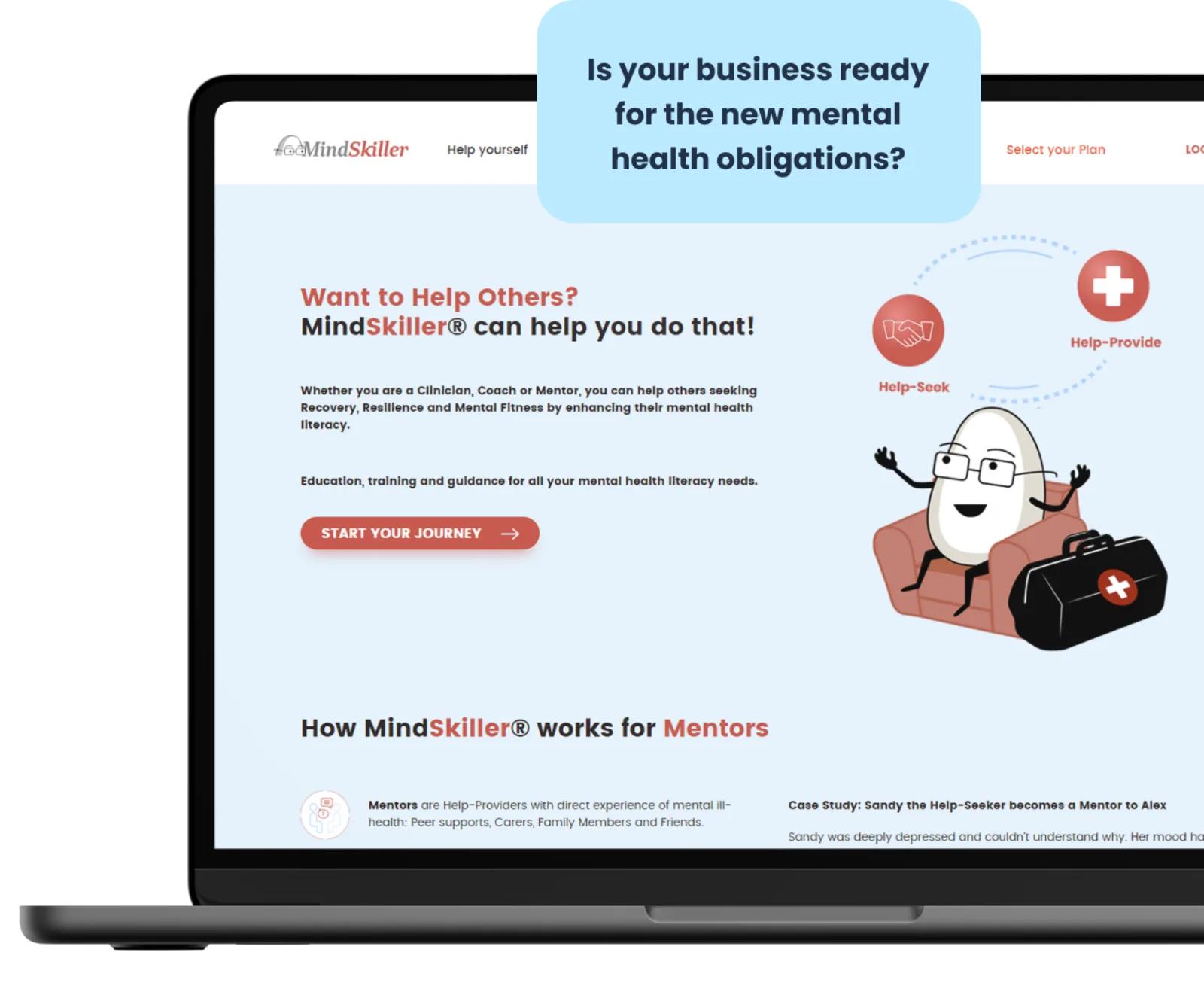
MindSkiller helps organisations demonstrate compliance with their OH&S mental health obligations
Transforming fragmented mental healthcare into coherent, data-driven shared care pathways. Employers must now be proactive in managing the risk of psychosocial hazards in the workplace under new Common Law Duties of Care, Codes of Practice and Commonwealth and State Legislation.
- Kozarov v Victoria (2022) High Court
- Bursee v State of Victoria (2022) Victorian Court of Appeal
- Debus v Condor Energy Services Limited (2022) Federal Circuit and Family Court of Australia
- Synergy Scaffolding Services Pty Ltd v Alelaimat (2023) New South Wales Court of Appeal
- Wilson v Gold Coast Hospital and Health Services (2023) Queensland Supreme Court
- Work Health and Safety Regulation 2017 (NSW)
- Work Health and Safety Act 2011 (ACT)
- Occupational Health and Safety Act 2004 (Vic)
- Work Health and Safety Regulation 2011 (Qld)
- Work Health and Safety Act 2012 (SA)
- Work Health and Safety Act 2020 (WA)
- Work Health and Safety Act 2012 (Tas)
- Work Health and Safety (National Uniform Legislation) Act 2011 (NT)
- Anti-Discrimination and Human Rights Legislation Amendment (Respect at Work) Bill 2022 (Cth)
- Safe Work Australia — Code of Practice, Managing Psychosocial Hazards at Work (2022)
Note: This is legal information not legal advice.

A psychosocial hazard in the workplace is anything that could cause harm to someone’s mental health.
The impact of not managing psychosocial hazards within your organisation may include:
Common psychosocial hazards at work include:
- Job demands
- Poor physical environment
- Low job control
- Violence and aggression
- Inadequate reward and recognition
- Harassment including sexual harassment
- Poor support
- Bullying
- Poor organisational change management
- Conflict or poor workplace relationships and interactions
- Poor organisational justice
- Lack of role clarity
- Traumatic events or material
- Remote or isolated work
- Psychosocial hazards at external locations
- When psychosocial hazards interact or combine

How MindSkiller Can Help
MindSkiller is a risk management platform that can help your organisation comply with the 5 key obligations under new Duties of Care, Codes of Practice and Legislation.
1. Identify Psychosocial Hazards
- Purpose-built tools for managers and employees to identify risks
- Specialist-grade education in mental health literacy
- Certificates of accomplishment in mental health literacy
2. Assess the Risks
- Assessment tools for managers to determine the degree of risk
- Pathways to manage identified psychosocial hazards
- Outcome measures and management plans for individual staff
3. Control the Risks
- A team-based approach to address psychosocial hazards
- Real-time educational support via video-conferencing
- A registry of accredited digital and in-person mental health services
4. Review the Control Measures
- Alerts and reminders for managers and staff
- Monitor for any new psychosocial hazards
- Reassess the effectiveness of control measures
5. Record the Risk Management Process
- Record all efforts to identify, assess, control and review psychosocial hazards
- An active WH&S framework regarding the risks posed to staff
- A psychiatrist-led and evidence-based mental healthcare approach
Outcomes of Effective Management of Psychosocial Hazards
- Talent attraction and retention
- Increased productivity
- Mental health cost impact mitigation

By investing in mental health education, support and innovation, organisations can use the MindSkiller® platform to manage mental health risks in the workplace more effectively.
An Easy Six-Step Solution
Let’s talk! Step 1Subscription
 Step 2Business Setup / Admin Portal
 Step 3Staff Online Registration
 Step 4Access to Online Mental Health Tools
 Step 5Monitoring
 Step 6Reporting